

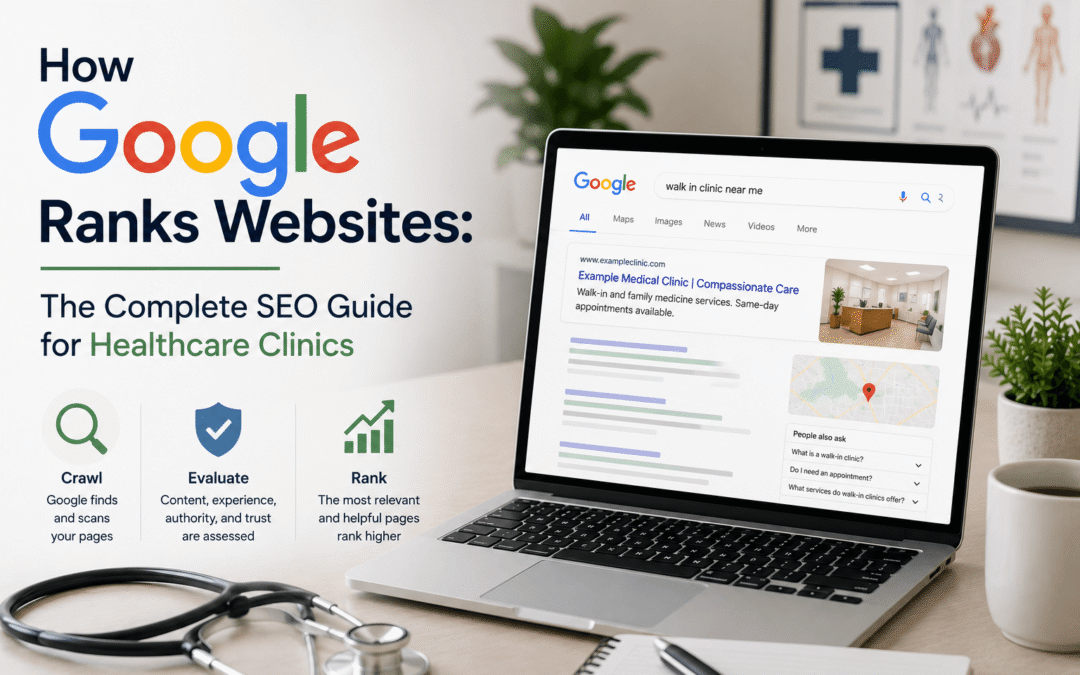
Google ranks websites by trying to show the most relevant, useful, trustworthy, and accessible results for each search.
For healthcare clinics, this means SEO is not just about keywords. It is about helping patients find accurate clinic information, understand services clearly, and decide whether to contact the clinic.
For clinics, the keyword “how google ranks websites” often connects to a practical question: why do some clinics appear higher than others when patients search for medical services nearby?
How Google Ranks Websites
Google uses automated ranking systems that evaluate many signals across web pages and search queries. According to Google Search Central, these systems are designed to identify helpful, reliable information and match it to what the searcher likely needs.
In simple terms, Google considers what the searcher is looking for, whether your page answers that intent clearly, whether your content appears useful and reliable, whether Google can crawl and understand your website, whether your page is usable on mobile and desktop, whether your clinic has local relevance, and whether your website shows trust signals.
For healthcare clinics, ranking well usually requires a mix of strong service pages, accurate Google Business Profile information, local SEO, technical website quality, and careful healthcare content.
Why SEO Matters More for Healthcare Clinics
Healthcare searches are high-trust searches. Patients may be looking for a doctor, clinic, health service, appointment option, treatment information, or urgent care guidance. Because these decisions can affect health and wellbeing, clinic content should be clear, accurate, and cautious.
A healthcare clinic website should avoid exaggerated promises such as “guaranteed results,” “best clinic,” “fastest recovery,” or “100% safe.” Instead, it should explain services in a way that is useful, specific, and responsible.
Good healthcare SEO helps patients answer questions such as:
- What does this clinic offer?
- Where is the clinic located?
- How can I book an appointment?
- What should I expect during a visit?
- Is this service appropriate for my concern?
- When should I seek professional medical advice?
- Can I trust the information on this website?
The Main Factors That Help Google Understand Clinic Websites
1. Search Intent
Search intent means the reason behind a search. A person searching “walk-in clinic near me” has a different need than someone searching “what is physiotherapy for back pain.”
Healthcare clinic pages should match the patient’s intent. For example:
- A service page should explain the service and how to book.
- A condition page should explain symptoms in general educational terms.
- A location page should help patients find the clinic.
- A blog article should answer a specific question clearly.
- A FAQ should give concise, direct answers.
If your page does not match the user’s need, it may struggle to rank even if it includes the right keywords.
2. Helpful, People-First Content
Google’s guidance emphasizes content created for people, not content created mainly to manipulate rankings. For clinics, this means the content should help patients understand the topic safely and clearly.
Helpful clinic content should:
- Answer the main question near the top
- Use plain language
- Explain medical terms simply
- Avoid unsupported treatment claims
- Include clinic-specific details where appropriate
- Make next steps clear
- Stay updated when services, hours, or policies change
A page about “family medicine in Calgary,” for example, should not be generic copy with the city name added. It should explain what the clinic offers, who the service may be relevant for, how appointments work, and what patients should know before visiting.
3. Relevance and Keyword Clarity
Keywords still matter, but they should be used naturally. Google needs to understand what a page is about, and patients need to recognize that they are in the right place.
For the keyword “how google ranks websites,” this article uses the phrase directly, but it also includes related terms such as SEO, search intent, local ranking, healthcare clinic websites, Google Business Profile, helpful content, and technical SEO.
For clinic websites, keyword clarity often includes:
- Service names
- Condition names
- Location names
- Clinic type
- Provider type
- Appointment terms
- Patient questions
- Local search phrases
Example keyword themes for a clinic might include “walk-in clinic in Calgary,” “family doctor accepting new patients,” “physiotherapy for back pain,” “medical clinic near me,” “women’s health clinic Toronto,” and “virtual care appointment Ontario.”
The safest approach is to use keywords where they genuinely help the reader.
4. Website Structure and Crawlability
Google needs to crawl and understand your website before it can rank your pages. A clinic website should have a clear structure that makes important pages easy to find.
A strong clinic website structure may include:
- Home page
- About the clinic
- Services
- Individual service pages
- Conditions treated, if appropriate
- Locations
- Booking or contact page
- Patient resources
- Blog or education centre
- Privacy policy
- Accessibility information
- Terms or website policies
Internal links help Google and patients move between related pages. For example, a blog about Google rankings can link to WebNeuro’s SEO Services, Google Ads Management, and Hassle-Free Websites.
5. Local SEO and Google Business Profile
For healthcare clinics, local SEO is often one of the most important ranking areas. Many patients search with local intent, such as “clinic near me,” “dentist Calgary,” or “physiotherapy clinic in Edmonton.”
Google Business Profile can support local visibility when it includes accurate and complete information.
Important local SEO elements include:
- Correct clinic name
- Accurate address
- Current phone number
- Website link
- Updated hours
- Appropriate business categories
- Services listed clearly
- Photos
- Appointment link, if available
- Recent, authentic patient reviews
- Professional review responses
Clinics should avoid keyword stuffing in the business name. The name should reflect the clinic’s real-world name.
WebNeuro can support clinics with SEO Services, Google Business Profile optimization, local content, and review strategy.
6. Trust Signals and E-E-A-T
Google’s quality guidance often refers to experience, expertise, authoritativeness, and trustworthiness, commonly called E-E-A-T. For healthcare clinics, trust is especially important.
Clinic website trust signals can include:
- Clear clinic identity
- Provider names and credentials, where appropriate
- Accurate contact information
- Service descriptions reviewed by qualified staff
- Privacy policy
- Secure website connection
- Accessible patient information
- Clear disclaimers for educational content
- Last-updated dates on medical articles
- Sources for clinical or regulatory claims
This does not mean every page needs to be written like a medical journal. It means patients should be able to understand who is behind the content and why it is reliable.
7. Technical SEO
Technical SEO helps search engines access, understand, and display your website correctly. A beautiful clinic website can still underperform if it loads slowly, has broken links, or is difficult to use on mobile.
Important technical SEO areas include:
- Mobile-friendly design
- Fast page loading
- HTTPS security
- Clear page titles
- Descriptive meta descriptions
- Proper heading structure
- XML sitemap
- Clean URLs
- Schema markup where appropriate
- Working internal links
- No accidental blocking of important pages
- Accessible design basics
For healthcare clinics, technical SEO also supports patient experience. A patient who cannot find the booking button or read the page on mobile may leave before contacting the clinic.
8. Page Experience and Usability
Google’s systems consider whether pages are easy to use. For clinic websites, usability affects both SEO and conversion.
Good clinic page experience includes:
- Clear navigation
- Readable text
- Strong contrast
- Mobile-friendly layouts
- Fast-loading pages
- Simple booking paths
- Clear calls to action
- No intrusive popups
- Accessible forms
- Helpful location information
A clinic website should make common patient tasks easy, such as booking an appointment, calling the clinic, checking hours, finding parking information, or understanding what services are available.
9. Reviews and Online Reputation
Reviews can influence patient trust and may support local visibility. For healthcare clinics, reviews should be handled carefully.
Clinics can ask patients for honest feedback, but should avoid:
- Buying reviews
- Offering rewards for reviews
- Asking only happy patients
- Pressuring patients to leave positive feedback
- Asking patients to include medical details
- Responding with private health information
A review strategy should be neutral, privacy-aware, and consistent.
10. Backlinks and Local Mentions
Links from other websites can help Google understand that your clinic or website is a trusted resource. For clinics, useful links and mentions may come from:
- Professional associations
- Local directories
- Healthcare networks
- Community organizations
- Partner organizations
- Local media
- Educational resources
- Sponsorship pages, where appropriate
Avoid buying low-quality links or using spammy link-building tactics. In healthcare, reputation risk is not worth short-term SEO shortcuts.
How Healthcare Clinics Can Improve Google Rankings
Improving rankings usually requires steady work across content, local SEO, technical SEO, and trust.
A practical clinic SEO plan may include:
- Audit the current website.
- Fix major technical issues.
- Optimize Google Business Profile.
- Create or improve service pages.
- Build location-specific pages where accurate.
- Add helpful FAQs.
- Publish educational blog content.
- Improve internal linking.
- Add schema markup where appropriate.
- Monitor Search Console and Google Business performance.
- Review content regularly for accuracy and compliance.
WebNeuro’s Hassle-Free Websites and SEO Services can support clinics that need help improving website structure, visibility, and patient-facing content.
What Not to Do With Healthcare SEO
Some SEO tactics can create risk for medical clinics. Avoid:
- Keyword stuffing
- Publishing thin AI-generated pages without review
- Making unsupported treatment claims
- Copying competitor content
- Creating fake location pages
- Buying backlinks
- Using fake reviews
- Hiding important clinic information
- Publishing medical advice without appropriate review
- Claiming guaranteed rankings
Healthcare SEO should be built around accuracy, usefulness, and trust.
How WebNeuro Helps Healthcare Clinics Improve SEO
WebNeuro helps healthcare and clinic businesses improve their digital presence through website, SEO, advertising, content, and Google Business support.
Relevant WebNeuro services include:
- SEO Services for improving organic and local search visibility
- Hassle-Free Websites for clinic websites built with usability and search visibility in mind
- Google Ads Management for paid search campaigns
- Branding & Content for clearer clinic messaging and patient-friendly content
- Social Media Management for consistent online communication
For healthcare clinics, SEO should not rely on hype. It should help patients find clear, accurate, and useful information.
FAQ
How does Google rank websites?
Google ranks websites by using automated systems that assess relevance, helpfulness, quality, usability, context, and other signals. The goal is to show results that best match the user’s search.
How does Google rank healthcare clinic websites?
Google looks at the same broad ranking signals, but healthcare clinic websites should pay extra attention to trust, accuracy, local relevance, clear service information, and patient-friendly content.
What is the most important SEO factor for clinics?
There is no single factor. Clinics usually need helpful content, strong local SEO, a complete Google Business Profile, technical website quality, and trustworthy service information.
Does Google Business Profile help clinic SEO?
Yes, Google Business Profile can support local visibility for clinic searches. It should include accurate contact details, hours, services, categories, photos, and authentic patient reviews.
Can WebNeuro help my clinic rank higher on Google?
WebNeuro can support SEO, website improvements, Google Business Profile optimization, content, and digital marketing. Rankings cannot be guaranteed, but a structured SEO strategy can improve visibility over time.
Need Help Improving Your Clinic’s SEO?
WebNeuro helps healthcare clinics improve website structure, local visibility, Google Business Profile clarity, and patient-friendly content.
Book a Free Consultation